USMNT's World Cup run ends vs. Belgium in Seattle's final match
Published in Soccer
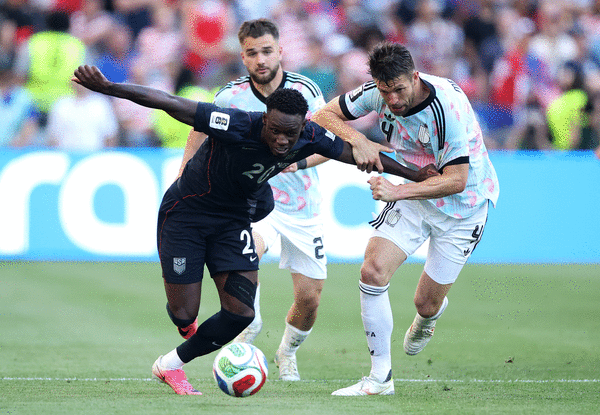
SEATTLE — A day of celebration. A night of frustration.
The FIFA Men’s World Cup came to an end in Seattle on Monday night with a day where the soccer community again showed up in force, only to watch the home team falter on the biggest stage.
The World Cup run of the United States came to a deflating conclusion on Monday night in a 4-1 loss to Belgium in the round of 16 before another sold out crowd of 66,925 at Seattle Stadium. The Belgians earned a date with Spain in Inglewood, Calif., on Friday, leaving in its wake a stadium wallowing with red, white and blue disappointment.
Arguably the biggest singular sporting event in Seattle history will be remembered as a dud for the home side and a massive missed opportunity for the men’s national team to take the next step in advancing its profile and with it the sport in the United States.
Charles De Ketelaere, with only one shot the entire tournament for Belgium, scored twice in the first half. His second goal came within two minutes of the U.S. drawing even on Malik Tillman’s free kick, his second straight game with a free kick goal.
Even though the Americans played with more aggression in the second half after a shockingly passive first 45 minutes, it was a critical mistake by U.S. goalkeeper Matt Freese flubbing a clearance with his foot digging into the grass turf that led to an open net and Hans Vanaken’s goal in the 57th minute that gave the Belgians a 3-1 lead.
Romelu Lukaku provided the final punctuation for Belgium scoring in the second minute of stoppage time, leaving only those in red and yellow dancing in the stands.
Going out in the round of 16 was not part of the American script for a tournament that galvanized even casual sports fans. Watching the U.S. during this tournament became required viewing.
But it was supposed to continue. Mauricio Pochettino was hired for this home World Cup to be a difference maker and elevating the U.S. to places it hadn’t before been. While that was arguably accomplished in terms of general interest, his efforts fell short where it mattered on the field.
The opportunity was there for the U.S. to make the quarterfinals for only the second time in the modern era of the World Cup and first time since 2002. But against Belgium, the Americans played like a team feeling every bit of the pressure being shoveled upon their shoulders and crumbled under the opportunity. The moment did prove to be too big.
The distractions of the 36 hours leading into the match should have helped the Americans because it meant that star striker Folarin Balogun would be on the field. The suspension of Balogun’s one-game ban for a red card sparked international controversy and debate. But instead of benefiting the U.S., it seemed mostly to spark the Belgians.
Perhaps the performance by the U.S. were the soccer gods balancing the ledger.
The U.S. had to sub off Christian Pulisic with an apparent foot injury. Balogun was a non-factor for the most part, although he forced a good save from Thibaut Courtois in the 82nd minute. It was one of the few U.S. threats over final 30 minutes.
Even Eddie Vedder slamming a beer on the video boards while Pearl Jam’s “Alive” played during the second-half hydration break couldn’t create a spark on the field.
All three host countries were eliminated within the span of 72 hours. Canada was knocked out by Morocco on Saturday, Mexico was defeated by England on Sunday and the Americans were the final piece of the puzzle sent packing.
The stakes of the matched seemed to hang over the pregame festivities. When the U.S. was here on June 19 against Australia, it was a party. This time, there was still the party vibe around the stadium and around the city, but it was twinged with anxiety.
This match was different. It was bigger. And the home team wasn’t able to come through.
____
©2026 The Seattle Times. Visit seattletimes.com. Distributed by Tribune Content Agency, LLC.






Comments