Commentary: 'Food. Water. Play. Every single day'? Not for a dog named Cash
Published in Variety Menu
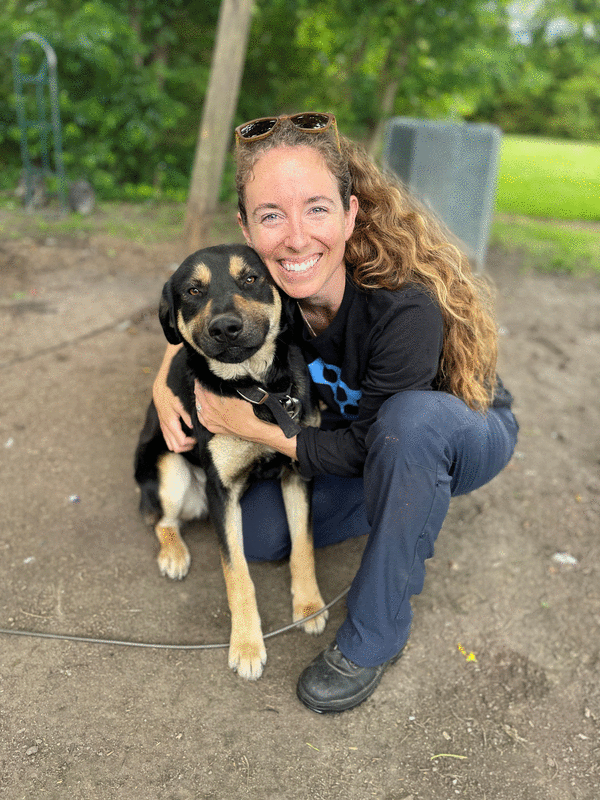
Amid record-breaking temperatures and headlines about “heat domes,” I worry profoundly about dogs like Cash, who spent his life deprived of relief from extreme weather—and everything else—while chained to a tree in North Carolina. Legislators there are considering Duke’s Rescue Act, a bill that would restrict tethering—a move we should all ask our own state legislators to make, given that millions of dogs like Cash are suffering across our nation.
“Food. Water. Play. Every single day.” The words were spray-painted in impossible-to-ignore lettering across the doghouse that my fellow PETA Community Animal Project fieldworkers delivered to Cash, like those we frequently bring other dogs kept chained and/or penned outdoors in northeastern North Carolina.
For the average canine guardian, these daily necessities are no-brainers. But for Cash—whom I found emaciated and dehydrated earlier this year—food and fresh water hadn’t come his way for days. And “play”? All that his owner appeared to play with was Cash’s life.
My coworkers and I had been visiting Cash for years. His owner repeatedly refused to surrender custody of Cash to PETA, despite the dog’s persistently poor condition. Local law enforcement didn’t intervene. So, PETA did what we could. We brought Cash straw bedding every winter and flea and tick preventative every summer. We filled his empty water bucket too many times to count. We transported him to and from a neuter appointment, vaccinated him, and secured treatment for his lesions, parasites, diarrhea, and dehydration. We patched up and expanded a pen already on the property so that Cash could be freed from his chain. All this was free to Cash’s owner.
And all that man had to provide were the basics: food, water, and play. But he failed. Miserably.
From the man’s driveway earlier this year, I easily saw Cash’s protruding hip bones and the ridges of his spine. I counted his ribs from 20 yards away. With his owner’s permission, I approached Cash, who was gaunt and hunched. The chain he was forced to tow around on his neck weighed a third of his bodyweight. He had no food. Only a few inches of dirty rainwater that had, mercifully, collected in his food bowl and water bucket could quench his thirst.
Cash—whom my colleagues had dubbed a “wild child” and whose hyperactivity often bordered on manic—was weak and struggled to right himself after stumbling repeatedly. His severely kinked chain limited him to maybe 3 feet of movement. He could barely get into his doghouse.
Only after I made clear to Cash’s owner my obligation to alert law enforcement did he surrender the skeletal dog to PETA. Hours after I conclusively freed Cash from his chain, a veterinarian confirmed what I’d suspected: His stomach was “completely empty,” and his bloodwork, physical exam findings, and X-rays were all “consistent with starvation.” He weighed only 30 pounds, just half of what he should have.
The only joy Cash ever knew as a “backyard dog” was thanks to PETA’s staff and donors. Because of our efforts, he will never again be lonely, scared, hungry, thirsty, or helplessly tangled.
With Duke’s Rescue Act, law enforcement across North Carolina would have the authority to intervene before dogs are reduced to skin and bones like Cash was. May we all urge our state legislators to end the continuous tethering of unattended dogs, particularly in extreme weather. Let’s keep our eyes open every single day for all the other Cashes out there and alert local law enforcement to their neglect.
_____
Katherine Sullivan is a fieldworker for People for the Ethical Treatment of Animals, 501 Front St., Norfolk, VA 23510; www.PETA.org.
_____
©2026 Tribune Content Agency, LLC.








Comments